Deel
Druk

Help my om dit te vind
Deel
Druk
Hierdie produk is gestaak en is nie meer beskikbaar nie. Vir onderhoudsinligting of verdere besonderhede, kontak
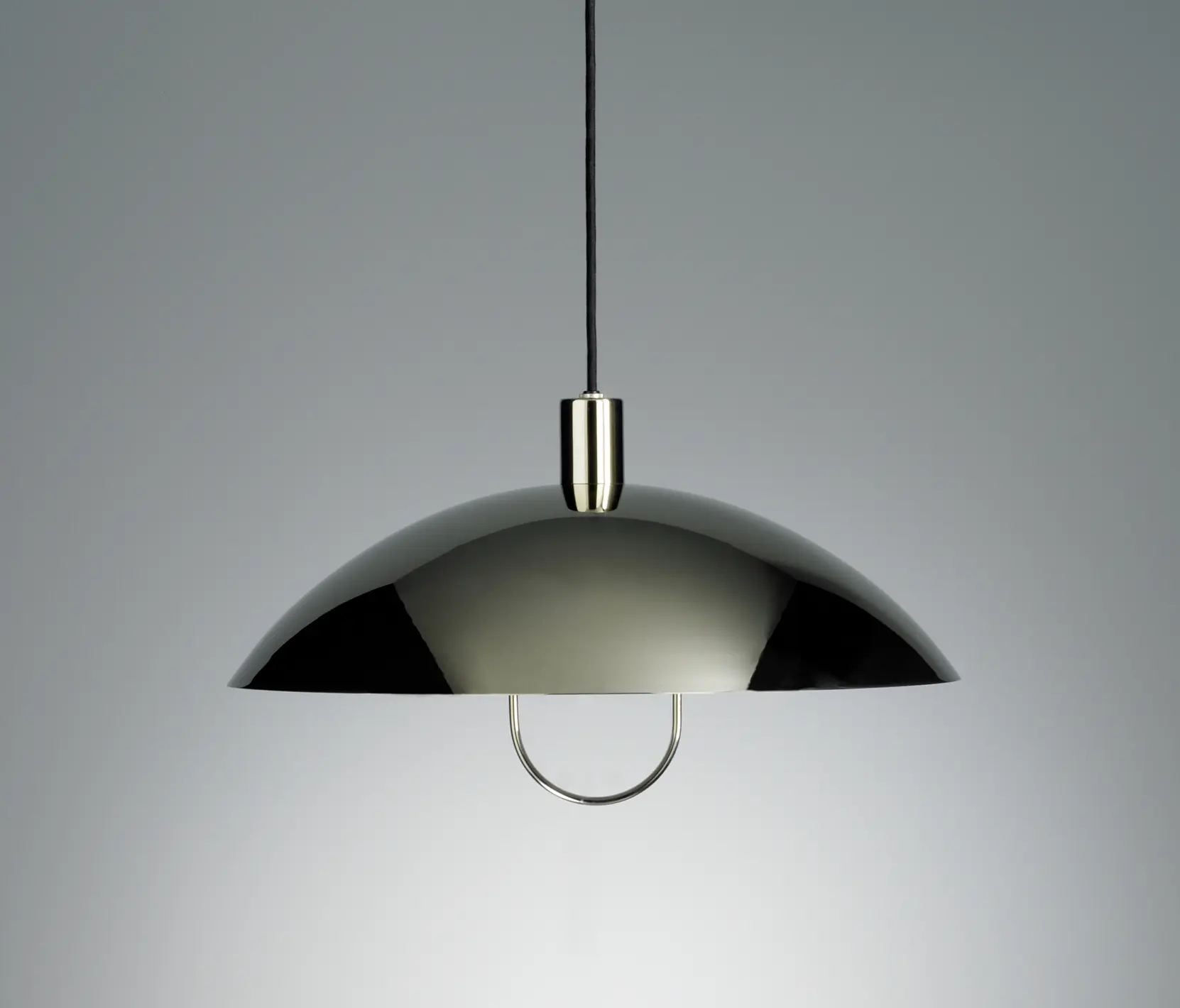
HMB25/500 Bauhaus Pendant lamp
Architonic ID: 1055836
SKU: HMB 25/500 …
Bekendstellingsjaar: 1925
Pendulum lamps by Marianne Brandt and Hans Przyrembel. Between 1924 and 1928, Marianne Brandt designed – in addition to smaller articles for common use such as ashtrays, china, etc. – quite a number of table, wall and pendulum lamps, which were also manufactured industrially in this period. For reproducing the pendulum lamps we had access to old catalogs, with exact specifications, as weIl as to two old models, one from the collection in the Bauhaus Archives in Berlin. Both versions (shade diameter 300 or 500 mm) are available with or without the pulley system.
HMB 25/300 Z Ni:
With pulley and counterweight. Polished nickel plated aluminium.
HMB 25/300 Z W:
With pulley and counterweight. Aluminium, white laquered.
HMB 25/300 Ni:
Without pulley and counterweight. Polished nickel plated aluminium.
HMB 25/300 W:
Without pulley and counterweight. Aluminium, white laquered.
Material: Pendant lamp with or without pulley and counterweight. Aluminium polished and nickel plated or Aluminium, white lacquered
Socket: E 27, max. 100 W
Hierdie produk behoort aan die volgende versameling:
Metal

Germany
Marianne Brandt (née Liebe) (1893–1983) was a pioneering German designer and one of the most influential figures of the Bauhaus movement. Trained initially as a painter, she joined the Bauhaus in Weimar in 1924 and soon became a leading student in the metal workshop, an area dominated by men at the time. Under the mentorship of László Moholy-Nagy, Brandt's innovative designs in metalwork — particularly her teapots, lamps, and ashtrays — came to embody the functional and minimalist aesthetics of the Bauhaus. Her iconic teapot design, created in 1924, is celebrated for its geometric purity and remains a landmark of 20th-century industrial design. Brandt later became the head of the Bauhaus metal workshop, making her one of the first women to lead a workshop at the school. Beyond her Bauhaus contributions, Brandt worked as a designer for the metalware company Ruppelwerk and later engaged in teaching and visual arts. Her legacy lies in her commitment to combining functionality with elegant simplicity, which helped shape modern industrial design and challenged gender norms within the field.

