Compartir
Imprimir


No disponible en CHF
Mostrar precio en
Architonic ID: 1271754
SKU: 412 324 00
Año de Lanzamiento: 1958
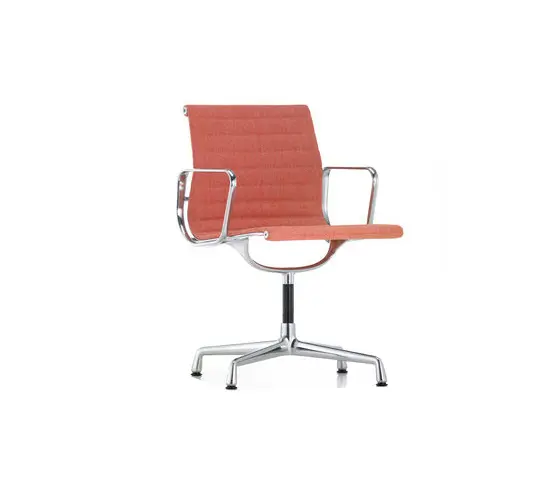
EA 104, Giratoria, Con reposabrazos
845 × 560 × 522 / 425 mm
Concepto
La Aluminium Chair es uno de los diseños de mobiliario más importantes del siglo XX. Charles y Ray Eames la diseñaron originalmente en 1958 para la vivienda privada de un coleccionista de arte de Columbus, Indiana (EE. UU.). Para la construcción de esta silla, los diseñadores abandonaron el principio de la carcasa de asiento y decidieron, en su lugar, tensar una superficie de tela o piel entre dos piezas laterales de aluminio para crear un asiento firme, pero elástico. La Aluminium Chair, con su fino acolchado, se adapta al cuerpo del usuario y resulta extraordinariamente cómoda.
El Aluminium Group incluye varios modelos distintos para su uso en hogares, oficinas y zonas públicas. Vitra fabrica las sillas del Aluminium Group desde hace varias décadas, siempre con la misma excelente calidad. Esta experiencia nos permite ofrecer una garantía de 30 años en todos los modelos de sillas del Aluminium Group.
Las Eames Aluminium Chairs EA 101, EA 103 y EA 104 son ideales para usarlas en combinación con una mesa: si se comparan con los demás modelos del Aluminium Group, sus asientos son más altos y estrechos, los respaldos más verticales y los brazos más cortos. Gracias a su amplia oferta de colores, es fácil encontrar la silla perfecta para cualquier ambiente, ya sea el comedor de casa, un restaurante o la sala de reuniones de la oficina.
Material:
– Respaldo y asiento: silla con respaldo medio-alto, posición sentada orientada a la mesa. Respaldo y asiento en tejido de malla o acolchado Hopsak con acanalado horizontal soldado a alta frecuencia. Perfiles laterales y travesaños de aluminio fundido a presión.
– Reposabrazos: aluminio fundido a presión.
– Base: base de cuatro radios de aluminio fundido a presión.
Este producto pertenece a la colección:
Aluminio, Base metal, Metal

Track
Material Type:
Fabric
Track
Details
Material Attributes, Available Colors

Laser RE
Material Type:
Fabric
Laser RE
Details
Material Attributes, Available Colors

Cosy 2
Material Type:
Fabric
Cosy 2
Details
Material Attributes, Available Colors

United States
Charles and Ray Eames are two of the most important product designers of the 20th century. The celebrated duo experimented with plywood, fibreglass, steel wire and aluminium, creating some of the most popular mid-century classics, including the Lounge Chair and Ottoman, the Aluminium Group chairs, and the DSW Chair. Charles & Ray Eames: a biography Charles Eames was born in 1907 in St. Louis, USA, and studied architecture at the Washington University in St. Louis. In 1938, he continued his studies at the Cranbrook Academy of Art in Michigan. He later became the head of the Design Department. Beatrice Alexandra (Ray) Kaiser was born in 1912 in Sacramento, California. She studied painting at Bennett College in New York before she met Charles Eames at the Cranbrook Academy. They married in 1941. As designers, Ray and Charles Eames experimented with moulded plywood, and together with Finnish architect Eero Saarinen, they won the “Organic Design in Home Furnishings” competition in 1940. In 1946, the duo's work was exhibited at the Museum of Modern Art (MoMA) in New York. In addition to their prodigious furniture output, the pair had also designed the IBM-Pavilion at the 1964 New York World's Fair. In 1969, they participated at the Musée des Arts Decoratifs exhibition “Qu'est-ce que le design?” and MoMA presented a retrospective of their work in 1973, entitled “Furniture by Charles and Ray Eames.” Charles Eames died in 1978, while Ray Eames died in 1988. The Work of Charles & Ray Eames The duo's early work is associated with the moulded plywood technique pioneered by Alvar Aalto. In 1956, they designed the famous Lounge Chair and Ottoman – a contemporary version of a club chair. The seat offers unparalleled comfort and quality, combined with luxurious materials such as rosewood and leather. In 1958, the designers followed up with the Aluminium Group, a series of chair designs using cast aluminium and a wide variety of canvas and leather seats, available in different colours. The chairs were easily adaptable to both office and home environments. Charles and Ray Eames also worked extensively with steel wire, as well as fibreglass and plastic. Eames House The Eames House was built as the couple's house and studio in 1949 in the Pacific Palisades neighbourhood of Los Angeles. Built as a part of the Case Study Houses Program initiated by Arts & Architecture magazine, it is sometimes known as Case Study House Nr. 8. The architecture of the Eames House serves as a frame for an ever-changing mix-and-match interior, in which Eames furniture was often paired with exotic and primitive objects. Eames Chair The Eames Chair combines comfort with high design, and the multitude of available seats, bases and colours enables combinations such as Plastic Side Chair and Eames Armchair and Eames Rocking Chair. The chairs were originally made from fibreglass, but are now produced from moulded plastic (polypropylene) by the manufacturer Vitra. Eames Hang it all Originally designed as a children's wardrobe, Hang it all is made of white steel wire and colourful wooden spheres. A modular design, it can be repeated almost endlessly without losing the compositional harmony of the original unit. Plywood Group The concept behind the Plywood Group furniture series was that three-dimensionally moulded plywood could be designed to fit human anatomy. Additionally, plywood furniture is light and durable, if treated correctly. The LCW Eames Chair optimises the support for the seat and the backrest by fastening the components to the steel frame with rubber screws, an innovation pioneered by Charles and Ray Eames. © by Architonic


