Condividere
Stampa


Varianti disponibili:


paper softwall | flexible freestanding partition
Architonic ID: 1274001
Anno di Lancio: 2003
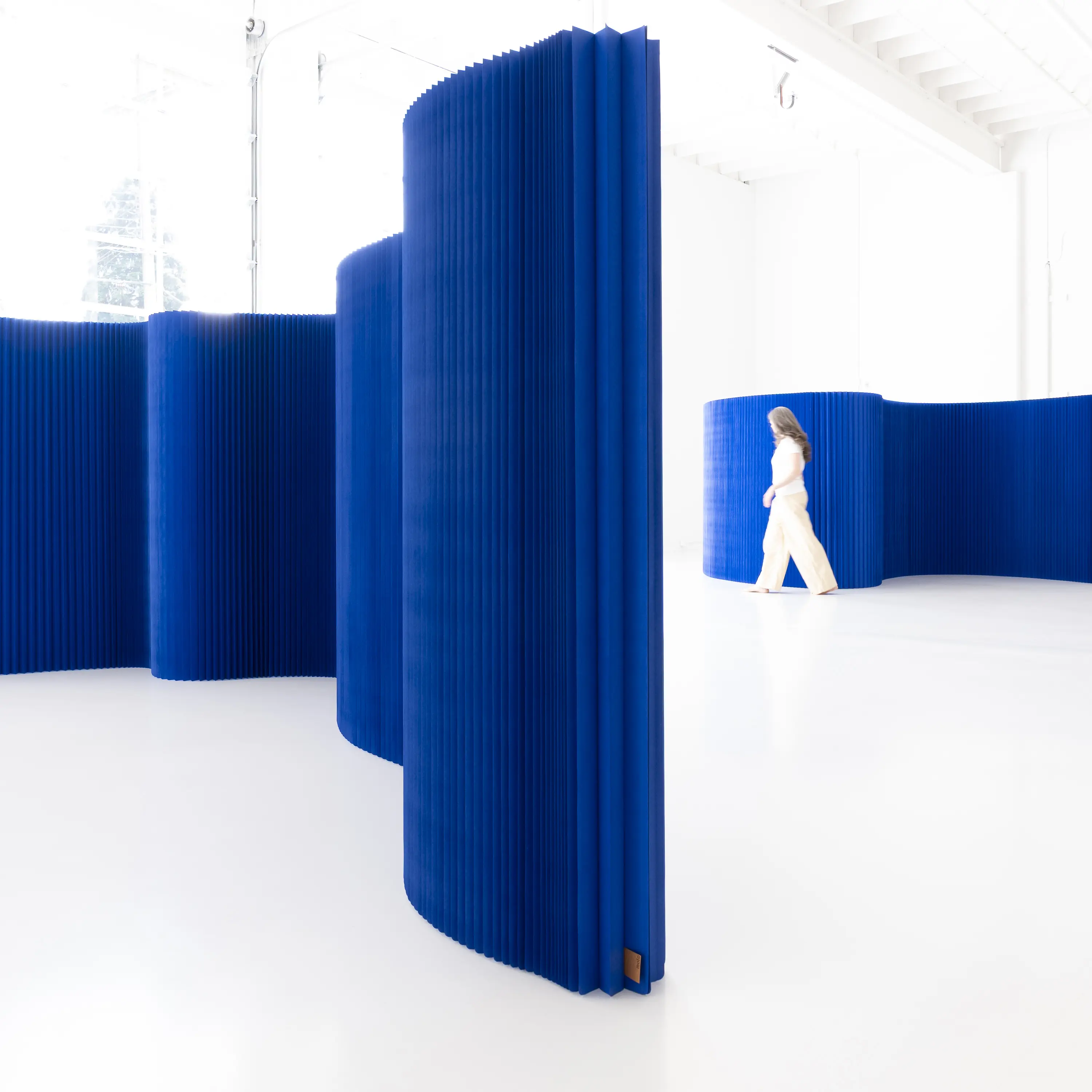
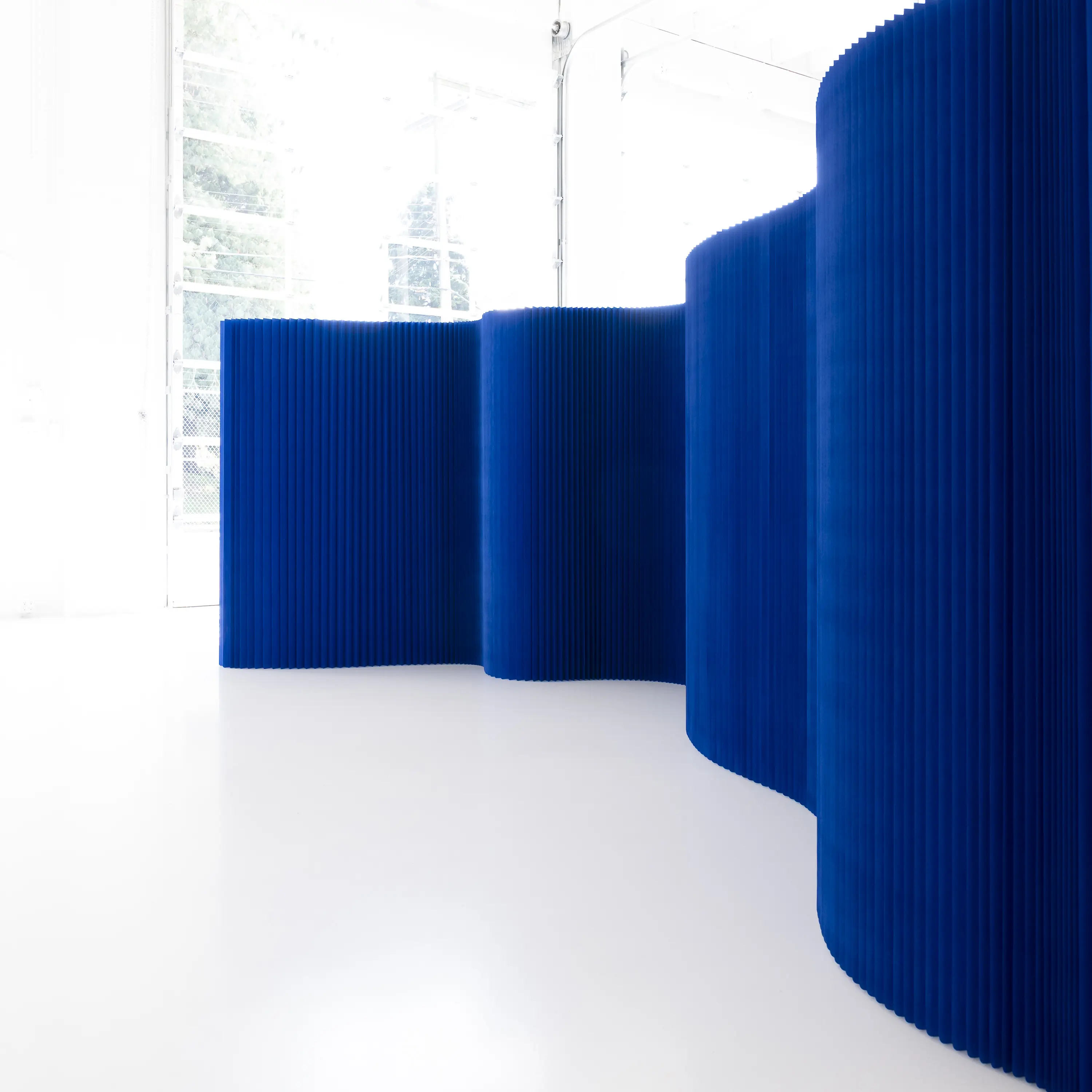
blue paper softwall | flexible freestanding partition
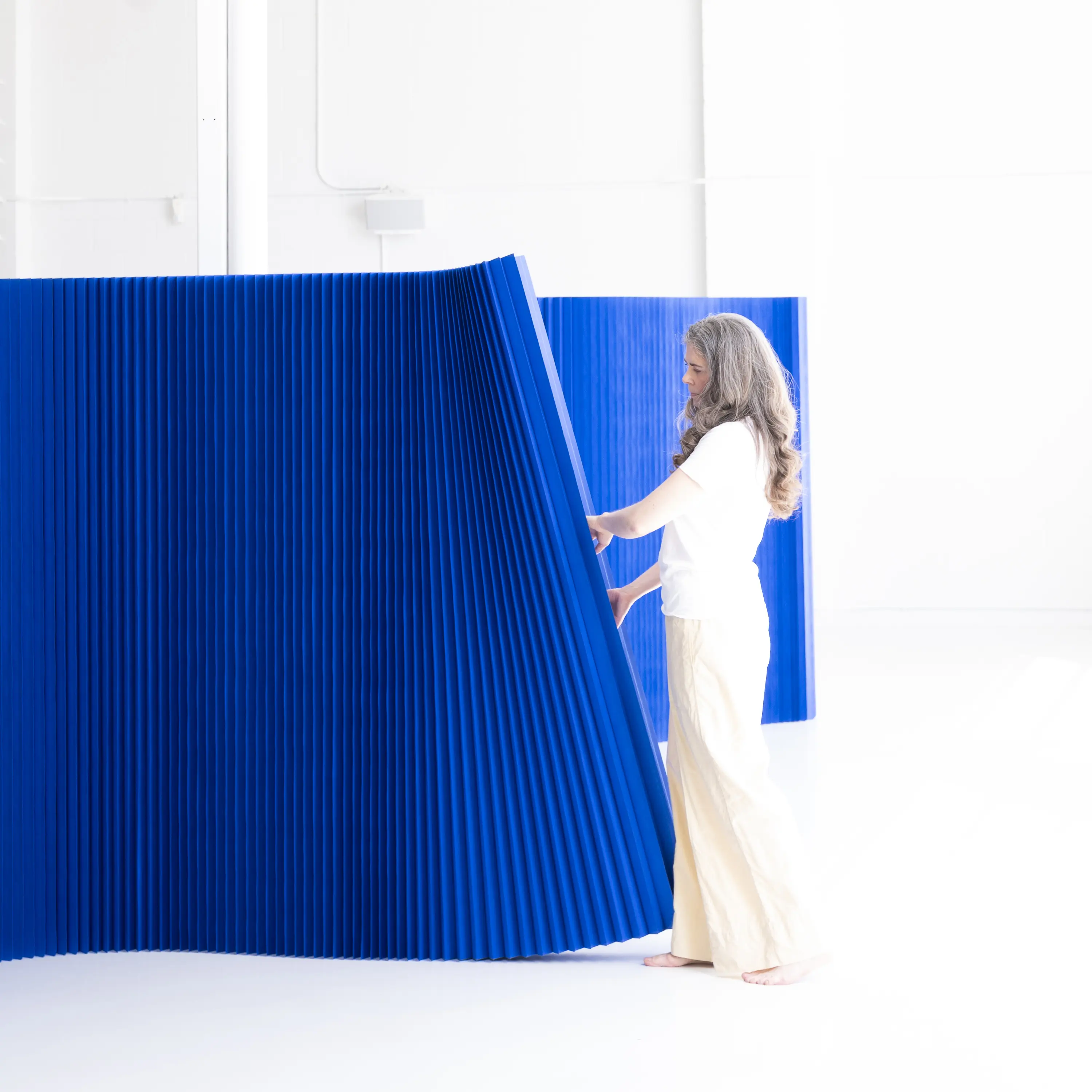
A freestanding space partition, paper softwall room divider is a modern partition design and folding wall that has the flexibility to be shaped in any curved or linear formation. When stored compressed, the folding wall shrinks to the thickness of a book. It expands to an impressive 15 feet (4.5 meters) long or any length between. Made from layers of paper structured with flexible honeycomb geometry, the walls are a new building material—relinquishing notions of rigid space-making in favour of sustainable design to accommodate change over time and responsible material use.
This easily moveable wall can be arranged as a room divider to absorb sound and delineate visual privacy or to create a striking backdrop for an event or performance. As a modular system, each softwall + softblock has magnetic end panels that connect these flexible building blocks to create longer partitions and immersive, sculptural installations.
Recognized for innovation and its elegant sculptural simplicity, softwall is in the permanent collection of the Museum of Modern Art, New York and won several awards, including the prestigious Danish INDEX Award for Design to Improve Life.
Design by Stephanie Forsythe and Todd MacAllen
available colours:
brown paper
black paper
blue paper
white textile
white textile with LED
forest green textile
black textile
aluminum textile
custom colour available in textile
colour:
brown paper softwall has a natural warmth. To achieve a deep, saturated black, the walls are dyed with bamboo charcoal ink. The indigo softwalls are likewise dyed to create rhythms of radiant blues and inky, dark shadows. White textile, made to order for molo, is a translucent bright white that has an impressive colour consistency over time. Black textile has an opaque sheen reminiscent of charred wood that highlights the subtle pattern of its fibres. For a nuanced tone-on-tone effect, pair black textile with the deep saturated flat black of paper softwall + softblock. aluminum textile is micro-coated with the actual metal, creating a lively yet soft range of reflected light and shadow across the pleated surface of the folding partitions. Custom colour partitions are also available.
material:
the paper used for brown and blue softwall is made from wood harvested from FSC® Certified (FSC® C158591) responsible sources. It is then coated with a non-toxic fire retardant and structured in layers to create softwall.
sustainability:
recyclable / responsible materials · The paper used for brown and blue softwall is made from wood harvested from FSC® Certified (FSC® C158591) responsible sources. It is then dyed and coated with non-toxic fire retardant and inks and structured in layers to create freestanding, flexible partition walls.
efficient use of material · When fully expanded, each softwall and softblock is 99% air and can easily be flat-packed for efficient storage and shipping. Light in weight and high in strength, the honeycomb allows the portable folding walls to be spontaneously rearranged to transform space.
flexible use of space · enabling a space to suit diverse use over time, throughout the day or over its lifespan, is a core concept of the soft collection and an inherently sustainable practice. softwall + softblock requires no tools or additional supports to create freestanding structures, and is easily folded away for storage or reconfigured. Whether for the temporal division of space in a live / work environment or shaping space for the unpredictable growth of a new business, the soft collection empowers people to change and adapt.
modular wall system:
softwall + softblock is a modular system of flexible space partitions with standard heights ranging from 1 – 10 feet tall (30.5 centimeters – 3.05 meters). Elements can be stacked vertically or connected horizontally by their magnetic end panels—making it possible to create endless lengths and impressive heights, stacking and linking walls and blocks to shape immersive environments.folding, flat pack furniture including tables and seating is available in the same brown paper as well as complimentary colours.
optional accessories:
magnetic connectors:
The final layer of softwall + softblock is a magnetic panel that folds vertically on itself to provide stability, connects multiple walls and blocks to one another, or anchors the elements to ferrous surfaces.
hook for softwall:
For storage or cleaning, a stainless steel hook can be used to hang compressed paper or textile softwalls from a solid wall or cabinet.
felt handle + anchor strip:
The optional steel strip accessory is powder-coated flat white and anchors the magnetic end panel of softwall to any solid surface. When paired with a felt handle, it creates a sliding door evocative of shōji.
Questo prodotto appartiene alla collezione:
Carta / cartone, Riciclabile, Materiali sostenibili
Puoi visitare la pagina del prodotto per queste varianti: basta cliccarci sopra!

Canada
Stephanie Forsythe and Todd MacAllen cofounded molo in 2003 and are best known for sharing their ideas and products for flexible, sustainable spacemaking around the world. Over the past three decades, the partners have worked together and led the Vancouver-based studio from humble beginnings to international recognition and acclaim. Along the way, they have assembled a dedicated team and a family of specialized manufacturers that support them in this endeavour. The partners work together to design all of molo’s products and projects, which range in size from a tea set to a museum. Forsythe and MacAllen met in 1994 while studying Architecture at Dalhousie University. Between 1994 and 2003, they worked together on several award-winning architectural projects and competition proposals. These projects included foundational investigations into materials, flexibility, and sustainable space making. The partners built molo around these early explorations and ideas, and they continue to drive the spirit behind the studio. Together, they designed and developed the iconic soft collection, a sculptural line of innovative, flexible space partitions, furniture, and lighting elements made from paper and textile. The award-winning soft collection is well known for its poetic beauty and pragmatic design. It experiences steady, iterative development as Stephanie Forsythe and Todd MacAllen continue their experiential and technical investigations, or as a sensitivity to nature and how the products interact with light and shadow inspires new finishes or colours. Stephanie Forsythe, Todd MacAllen, and molo hold over thirty-five patents and thirty design registrations. They have received numerous international design and architecture awards, including the prestigious Danish INDEX Award for Design to Improve Life for softwall, the Architectural Review AR + D Award for Colorado House, 2010 Emerging Voices Award from The Architectural League of New York and Grand Prize in the Aomori Northern Housing Competition. Their products have been acquired by many museum and gallery collections, including the New York Museum of Modern Art (MoMA), the Chicago Art Institute, Die Neue Sammlung, and the Cooper Hewitt Smithsonian Design Museum.

Canada
Stephanie Forsythe and Todd MacAllen cofounded molo in 2003 and are best known for sharing their ideas and products for flexible, sustainable spacemaking around the world. Over the past three decades, the partners have worked together and led the Vancouver-based studio from humble beginnings to international recognition and acclaim. Along the way, they have assembled a dedicated team and a family of specialized manufacturers that support them in this endeavour. The partners work together to design all of molo’s products and projects, which range in size from a tea set to a museum. Forsythe and MacAllen met in 1994 while studying Architecture at Dalhousie University. Between 1994 and 2003, they worked together on several award-winning architectural projects and competition proposals. These projects included foundational investigations into materials, flexibility, and sustainable space making. The partners built molo around these early explorations and ideas, and they continue to drive the spirit behind the studio. Together, they designed and developed the iconic soft collection, a sculptural line of innovative, flexible space partitions, furniture, and lighting elements made from paper and textile. The award-winning soft collection is well known for its poetic beauty and pragmatic design. It experiences steady, iterative development as Stephanie Forsythe and Todd MacAllen continue their experiential and technical investigations, or as a sensitivity to nature and how the products interact with light and shadow inspires new finishes or colours. Stephanie Forsythe, Todd MacAllen, and molo hold over thirty-five patents and thirty design registrations. They have received numerous international design and architecture awards, including the prestigious Danish INDEX Award for Design to Improve Life for softwall, the Architectural Review AR + D Award for Colorado House, 2010 Emerging Voices Award from The Architectural League of New York and Grand Prize in the Aomori Northern Housing Competition. Their products have been acquired by many museum and gallery collections, including the New York Museum of Modern Art (MoMA), the Chicago Art Institute, Die Neue Sammlung, and the Cooper Hewitt Smithsonian Design Museum.


